


|
Product Name
|
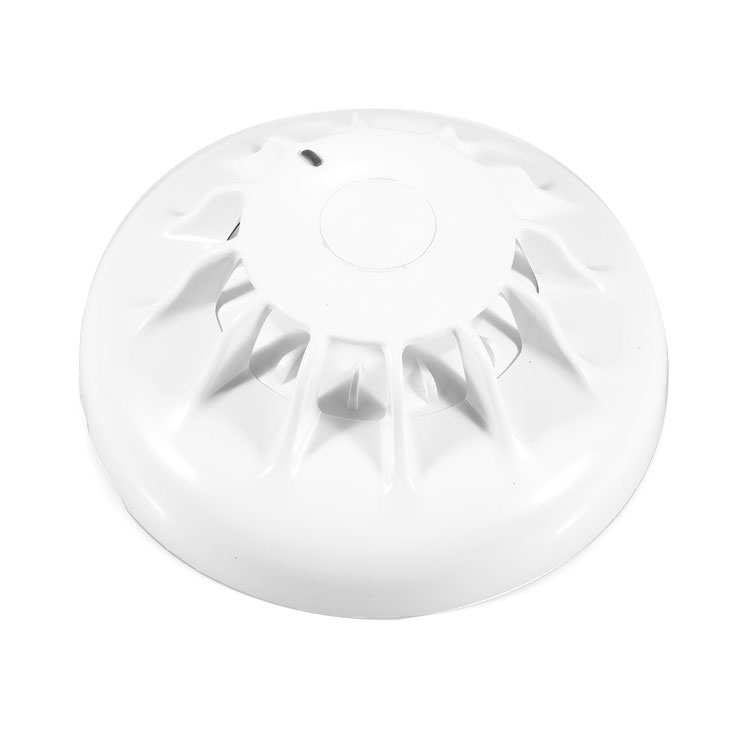
Heat Detector |
|
Model
|
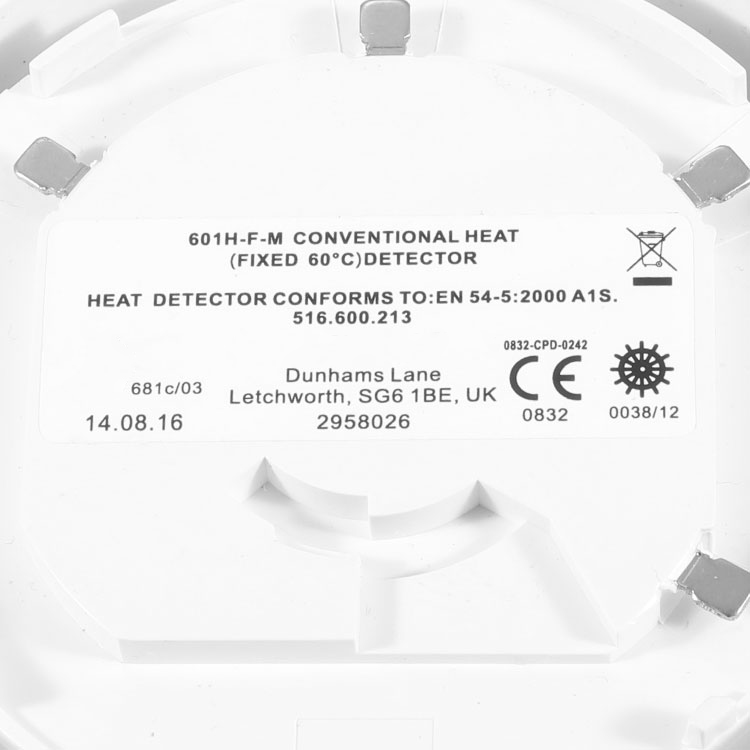
601H-F-M、711P |
| Material | Plastic hardware |
| Size | 110x110x42 |
| Conforms to | EN 54-5: 2000 A1S. 516.600.213 |
| Application Scenario | For building, industry factory, vessel fire alarm system. |

1、Ionization smoke detector:
Such detectors have an ionization chamber inside, which is filled with radioactive material and a small amount of air. When the smoke enters the ionization chamber, the smoke particles will adsorb to the electrodes in the ionization chamber, causing the current between the electrodes to change, which triggers the alarm. The positive and negative ions produced by the ionization of a radioactive source (such as Am-241) in the ionization chamber move towards the positive and negative electrodes under the action of an electric field. Under normal condition, the electric field is in a balanced state, and when smoke enters the ionization chamber, this balance relationship will be destroyed, and the alarm circuit will send an alarm when the concentration exceeds the set threshold.
2、Photoelectric smoke detector:
The scattering of light by smoke particles is used to detect smoke. This type of detector has an optical labyrinth inside, mounted with infrared tubes. When there is no smoke, the infrared receiving tube cannot receive the infrared light emitted by the infrared transmitting tube. When the smoke enters the optical maze, the infrared light is received by the receiving tube through refraction and reflection, and is converted into an electrical signal. The detection circuit amplifies this electrical signal and sends an alarm when the concentration exceeds a set threshold. The labyrinth of the photoelectric smoke detector is the core component, the smoke enters the maze through the smoke inlet seam, the smoke scatters the infrared emitted by the infrared emission tube, so that the infrared is received by the receiving tube, and the maze converts the light signal into an electrical signal, so as to detect the smoke.Both of these working principles of smoke detectors are based on the scattering of light by smoke particles, but the implementation methods are different. The ionized type is more suitable for sensing small smoke particles, while the photoelectric type is more sensitive to larger smoke particles. These two types of detectors have their own advantages in fire protection, and selecting the appropriate type according to the specific application scenario can improve the effect of fire protection.


